

What Not to Do After a Sports Massage
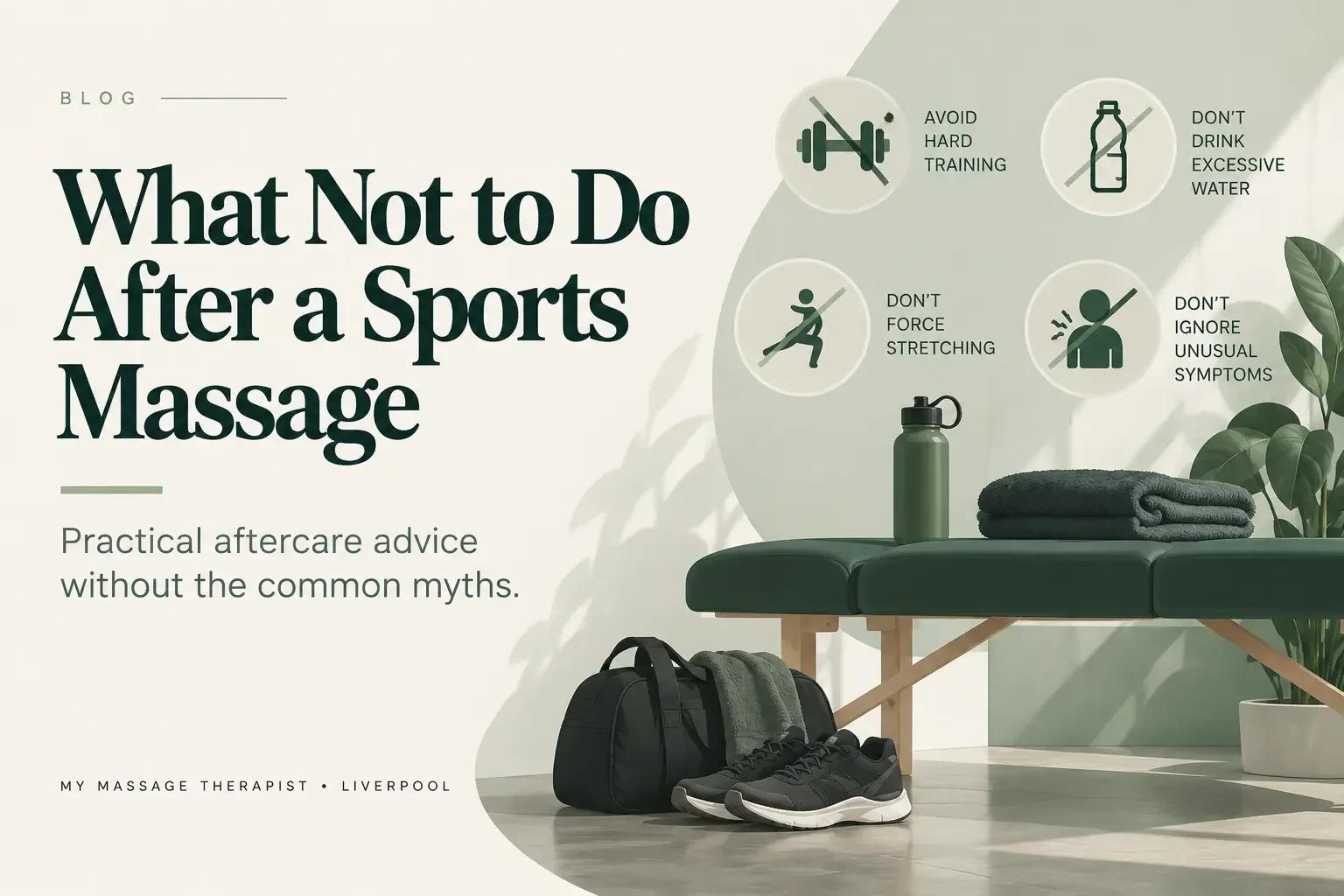
You don't automatically need to avoid exercise after every sports massage, but a hard session immediately afterwards may not make sense depending on the treatment.
Don't assume you need to drink excessive amounts of water to “flush” anything from your muscles.
Don't judge a sports massage by how sore or bruised you feel afterwards. Harder isn't automatically better.
Don't ignore unusual or worsening symptoms and assume they're a normal reaction to massage.
Follow aftercare based on your treatment, training and individual response rather than a generic list of post-massage rules.
If you've just had a sports massage, you might have been told to drink litres of water, avoid the gym, stretch everything and expect to feel sore the next day.
Post-massage advice doesn't need to be that rigid.
What not to do after a sports massage depends on the treatment you received, how you feel afterwards and what you're planning to do next. Someone having targeted treatment during a heavy training week may need different advice from someone having a lighter sports massage before an event.
Here are the main things I'd avoid.
What Should You Not Do After a Sports Massage?
After a sports massage, avoid jumping straight into very demanding exercise without considering how you feel, forcing stretches because you think you have to, drinking excessive water to supposedly “flush toxins”, and treating severe soreness or bruising as proof of a good massage.
You also shouldn't ignore symptoms that feel unusual or significantly worse after treatment.
There isn't one universal list of things everybody must avoid for exactly 24 or 48 hours.
A large research review of 29 studies involving 1,012 participants found massage was associated with small improvements in flexibility and delayed onset muscle soreness (DOMS), but it didn't improve measures of strength, sprinting, jumping, endurance or fatigue.
That helps put post-massage advice into perspective.
Massage can be useful around training and recovery, but there's no need to build an elaborate recovery ritual around every appointment.
Don't Assume You Have to Stop Training
You don't automatically have to stop training after every sports massage.
What you're planning to do, what was treated and how you feel afterwards all matter.
A light training session several hours after a relatively mild treatment is very different from attempting heavy squats immediately after intensive work on already sore legs.
That's why I prefer to know what's coming up in your training.
If you've got a major session, competition or race shortly after your appointment, tell me. I can take that into account when deciding how the treatment should be approached.
I don't automatically tell every client to stop exercising after massage.
Depending on the situation, it may make more sense to modify a session, reduce an aggravating movement or continue with activity you're tolerating well.
There's also no strong reason to assume a massage itself will improve your next workout. A systematic review of pre-performance massage found no evidence that massage improved maximal strength, sprint or jump performance. Longer passive massage immediately before performance showed some evidence of negative effects on certain performance measures.
So if you've just had substantial treatment and your legs feel different, heading straight to the gym to test your 1RM probably isn't the most useful way to judge whether the massage worked.
Don't Drink Litres of Water to “Flush Out Toxins”
You don't need to force down excessive amounts of water after sports massage to flush toxins or lactic acid from your muscles.
Hydration matters for general health and exercise, but that's different from claiming massage releases substances that then need to be flushed from your body.
A 2023 systematic review covering 114 articles found massage didn't change blood lactate clearance.
That's one reason I don't explain sports massage using the idea that I'm pushing lactic acid or toxins out of your muscles.
Drink according to your normal needs, your activity, environmental conditions and any individual health advice you've been given.
If you've trained hard in hot conditions and sweated heavily, your hydration needs may obviously be different from someone who's spent the afternoon sitting at a desk.
That's because of the exercise and fluid loss, not because your massage created toxins that need to be washed away.
Don't Assume Soreness Means the Massage Worked
A sports massage doesn't need to leave you extremely sore or bruised to be worthwhile.
Some areas can feel tender during or after treatment, particularly if you're already sore from training. But severe discomfort isn't the target.
The “no pain, no gain” mentality doesn't translate particularly well to massage.
At My Massage Therapist, pressure is adjusted to the individual and the presentation. Very deep pressure, severe discomfort or bruising doesn't automatically mean better treatment.
There's also no reason to keep increasing pressure simply because you're an athlete or lifter.
Sports massage is about making the treatment relevant to what you need, not seeing how much pressure you can tolerate.
This matters after the appointment too.
Don't use next-day soreness as your scorecard for whether you received a “good” massage. A useful session doesn't have to leave you struggling to walk down the stairs.
Don't Schedule a Very Hard Massage Without Considering Your Next Session
If you've got an important training session or competition coming up, don't treat your massage appointment as completely separate from your training schedule.
Timing can matter.
Research into pre-performance massage hasn't shown improvements in maximal strength, sprint or jump performance. In that review, longer massage immediately before performance tended to have negative effects on some lower-body performance measures.
That doesn't mean sports massage should never be used around competition.
I've worked with CrossFit athletes before events where tightness was making positions such as the overhead squat or snatch receiving position feel restricted. I've also worked with basketball players during demanding competitive periods where their calves, ankles, legs and upper-body muscles had been heavily worked.
The treatment needs to reflect what's coming next.
If you have an event tomorrow, tell your therapist. If you're planning heavy deadlifts that evening, mention that too.
Treatment intensity and technique selection can then take your schedule into account.
Don't Force Yourself to Stretch Everything Afterwards
You don't need to perform a full-body stretching routine simply because you've had a sports massage.
Stretching can be appropriate when there's a reason for it, but generic stretching isn't automatically required after every appointment.
If I identify something during your assessment that would benefit from a particular mobility exercise or stretch, I may include that in your exercise aftercare.
In other situations, strengthening or movement-control work may be more relevant.
And sometimes you don't need a list of exercises at all.
Your aftercare should have a purpose rather than being extra homework added to every appointment.
Don't Ignore Symptoms That Feel Unusual
Don't automatically assume every symptom after a sports massage is normal post-treatment soreness.
Massage therapy generally appears to have a low risk of harmful effects, but that doesn't mean every reaction should simply be ignored. The US National Center for Complementary and Integrative Health notes that serious adverse events are rare, with some reported cases involving vigorous massage or people at increased risk. Massage safety therefore still matters.
If you're experiencing significant or worsening pain, unusual numbness or tingling, marked swelling, significant bruising or another symptom that concerns you, don't simply assume you need to “push through it”.
Contact your therapist or seek appropriate medical advice depending on the symptoms.
The same principle applies before massage.
If you've had an acute injury, unexplained neurological symptoms or another issue that may need medical assessment, massage shouldn't be used to delay appropriate healthcare.
Don't Expect Massage to Replace Recovery Basics
Sports massage can be one part of your approach to training and recovery, but don't use it as a substitute for everything else.
If you're consistently exhausted, sleeping poorly and doing more training than you're recovering from, another massage doesn't automatically solve that problem.
A meta-analysis of 22 randomised controlled trials found the effects of massage on performance recovery were generally small, although outcomes varied according to the circumstances.
Research is more encouraging for certain outcomes such as muscular soreness. The larger sports massage review found a small improvement in DOMS, for example.
That's useful, but it's different from saying massage accelerates every part of recovery.
Your training load, sleep, nutrition and appropriate time between demanding sessions still matter.
If the same area repeatedly becomes tight or uncomfortable, it can also be worth looking beyond the massage table.
Depending on your presentation, relevant strength, movement, training volume and exercise selection may need to be considered.
Don't Assume More Treatment Is Always Better
You don't need the hardest techniques, the longest appointment and every treatment tool available just because you've booked a sports massage.
Treatment should be selected because it's relevant.
At My Massage Therapist, a sports massage appointment can include assessment, targeted hands-on treatment, reassessment and practical aftercare where appropriate.
Techniques may include sports or remedial massage, deep tissue techniques, trigger point therapy and stretching.
IASTM may also be incorporated briefly where appropriate.
That doesn't mean every technique needs to be used in every appointment.
Adding more techniques doesn't automatically make the treatment better.
What Should You Do After a Sports Massage?
After a sports massage, pay attention to how you feel, follow any treatment-specific advice you've been given and consider what physical activity you have planned next.
For many people, the basics are fairly straightforward:
Return to normal activity according to how you're feeling and the advice you've been given
Adjust a demanding workout if the treatment or your symptoms make that sensible
Drink normally according to your hydration needs
Complete prescribed exercises or mobility work where relevant
Pay attention to how the treated area responds
Contact your therapist if you're unsure about an unexpected reaction
Seek appropriate healthcare if you develop concerning symptoms
You shouldn't need a complicated set of rules after every appointment.
If I've given you a specific exercise, training modification or movement recommendation, I'll explain why it's relevant rather than handing you a generic aftercare checklist.
Can You Go to the Gym After a Sports Massage?
You may be able to train after a sports massage, but whether you should do your planned workout depends on the treatment, your symptoms and what the session involves.
There's a big difference between going for an easy walk and attempting heavy lower-body training after substantial treatment to your quads, hamstrings and calves.
There's also a difference between someone booking because of general muscular soreness and someone being treated for a specific problem that's already affecting training.
If possible, tell your massage therapist what you're planning to train afterwards.
That gives the therapist useful context before treatment rather than discovering at the end of the appointment that you've got a competition in three hours.
How Long Should You Rest After a Sports Massage?
There isn't a universal number of hours everyone needs to rest after sports massage.
You may see recommendations online telling everybody to avoid exercise for 24 or 48 hours. That kind of fixed rule doesn't account for treatment intensity, why you booked, your symptoms or what activity you're returning to.
Your advice should be based on your individual situation.
After some appointments, continuing normal activity may be perfectly reasonable.
After others, particularly if you've had substantial treatment to already sore muscles or you're dealing with a specific problem, temporarily modifying your training may make more sense.
Individual responses vary.
Should You Feel Sore the Day After a Sports Massage?
Some people may experience temporary tenderness after sports massage, particularly following more intensive treatment, but you don't have to be sore the next day for the treatment to have been worthwhile.
How you respond can vary with treatment pressure, the areas treated and how those muscles felt before the appointment.
If you're already dealing with DOMS after a demanding training session, for example, the area may already be sensitive.
Research suggests massage itself may actually help with perceived post-exercise soreness. A large systematic review found a small improvement in DOMS.
So deliberately chasing post-massage soreness doesn't make much sense.
Sports Massage Aftercare in Liverpool
At My Massage Therapist in Liverpool, I work with CrossFit athletes, lifters, runners, gym-goers and other active people.
I don't give everyone exactly the same post-massage instructions.
I want to know what you've been training, what's bothering you and what you've got coming up next. That information can influence both the treatment and the advice you receive afterwards.
Where appropriate, I may also provide strengthening, mobility or movement recommendations to work on between appointments.
If you're booking around an important competition or demanding training session, mention it when you attend so I can factor that into your treatment.
My Massage Therapist
92 Flowerdale Road, Liverpool NSW 2170
Frequently Asked Questions
Can I Exercise After a Sports Massage?
Potentially, yes. There isn't a universal rule saying everyone must avoid exercise after massage.
Consider what was treated, how you feel and what type of exercise you're planning. Your therapist may recommend modifying your session depending on your presentation.
Can I Lift Weights After a Sports Massage?
It depends on the treatment and the lifting session.
If you've had substantial treatment to an area you're about to train heavily, tell your therapist. Your treatment and subsequent training may need to be adjusted accordingly.
Should I Drink Lots of Water After a Sports Massage?
You should meet your normal hydration needs, but you don't need to force excessive amounts of water down because you've had a massage.
The idea that you need water to flush massage-released toxins or lactic acid isn't how I explain treatment.
Should I Stretch After a Sports Massage?
Only where it's appropriate.
A specific stretch may form part of your aftercare, but everyone doesn't need a generic stretching routine after massage.
Can I Have a Hot Shower After a Sports Massage?
For most people, normal showering doesn't need to become complicated just because they've had a massage.
If you have a health condition that affects how you respond to heat, follow the relevant medical advice for that condition rather than a generic massage rule.
Is It Normal to Feel Sore After a Sports Massage?
Temporary tenderness can occur, particularly after more intensive treatment or when an area was already sore.
Severe pain or bruising isn't the goal, though. If your symptoms are significant, worsening or concerning, contact your therapist or seek appropriate healthcare depending on the situation.
Should I Rest for 24 Hours After a Sports Massage?
Not automatically.
There isn't a universal 24-hour rest requirement. Your next activity should reflect your treatment, symptoms and how you're feeling.
What Not to Do After a Sports Massage: The Bottom Line
The biggest mistake after a sports massage is treating generic aftercare rules as if they apply to everyone.
You don't automatically need to stop training for 24 hours, force yourself to stretch or drink litres of water. You also shouldn't assume that severe soreness means you've had a more effective treatment.
Pay attention to how you feel, consider what you're doing next and follow advice that's relevant to your individual appointment.
If you're booking sports massage around your training, race or competition schedule, tell your therapist. Good aftercare starts with understanding what you're actually trying to get back to doing.
